IMPORTANT! Optimized for Firefox and Google Chrome. You may not be visualizing the entire blog if you are using Internet Explorer.
Feel free to send your ideas to my email: mariazabalapena@gmail.com / englishforeso@yahoo.es. To use the lesson plans in my blog, you do NOT need photocopies for students. You MAY need to print instructions or to use a projector and/or a computer.

For ESL VOCATIONAL TRAINING LESSON PLANS go to my other blog HERE
Browse LABELS to the right, underneath to find prompts and tasks.New!! VIDEO BLOGS on English for Communications and on English for Office Applications (Computers). See links below.

* English for Communications. Click HERE. By Beatriz Papaseit Fernández and myself, María Zabala Peña

* English for Office Applications (Computers :Word 2007 and more). Click HERE. By Beatriz Papaseit Fernández and myself, María Zabala Peña
Showing posts with label Pronunciation. Show all posts

Sunday, October 2, 2016

Word stress puzzles


Level: lower levels. From A 1 to B1
Melon Maze from Hancock Mcdonald Page
Procedure:   
  • Students work in pairs.
  • Project maze grid on board
  • Students say the words aloud  to decide the path that allows them to get through the maze
Football Maze from Hancock Macdonald Page
Materials:
  • Projector 
  • Totally necessary : Mazes to project (you can make some photocopies if projector is not available)
  • There are two mazes: melon maze and football maze. Depending on the first word of  the maze.  
  • Not necessary but a plus : Recording of words


Go to  Handcock Mcdonald´s  page to download the mazes, project them  on board and start playing:

http://hancockmcdonald.com/materials/melon-maze 

Do you want to view a list of word that most Spanish speakers mispronounce? Click HERE

Thanks to Carmen Santamaria Pena for sharing these materials at the 2016 British Council Barcelona Teacher-s meeting  

Friday, July 12, 2013

Elllo Listening Site. Listen, read the script (if needed) and take the quiz


Elllo stands for English Lesson Listening Library. It  is a short video site or slide share site  where students can listen to  and view short videos/presentations. There is a script for the texts you hear and the recordings are pretty clear. When you finish listening you can just do the listening quiz.

LEVEL:  Lower intermediate or upper 

Warning:  It might be difficult to find the audios  you like as the web is a bit chaotic and you seem to need either the number of the video or the name of the  series to which it belongs. 

This is the link to the site: HERE


See the links to the videos I have chosen  for you below but feel free to browse around!

 
These are some of the examples you may like:

a. Trip to Cambodia:  Julia tells us about a memorable trip in Cambodia to raise money for a charity. .It includes the audio and a slide presentation of her trip as well as the script, vocabulary and quiz. There are 4 presentation on the same subject.

Click HERE


b. Take a peek at the section  "Talking Points"
My suggestion:
  • TAKE THE QUIZ
  • LISTEN 
  • TAKE THE QUIZ AGAIN
  • CHECK THE SCRIPT IF YOU FEEL YOU NEED TO
These are the Talking points I liked: 

b.1. American cities  HERE. 
b.2. Best movies ever HERE
b.3. Different jobs the speaker (Todd)  has had HERE

To access the Talking Point series, click HERE


Thanks to my colleagues at the Training British Council Course 2013 for recommending this site.

Sunday, May 5, 2013

Pronunciation: How do you pronounce...?

"How you say" is an on-line tool that will help you to learn how to pronounce words.
Aim: students introduce words they do not know how to pronounce in order to learn them with the sound Suggested procedure if you want to use this tool in your class
  •  make a list of the words students mispronounce.
  • group students in teams
  • write the words on the board
  • ask teams (in turns)  how a word is pronounced
  • check the pronunciation by introducing the  in How j say
  • give a point to the team that pronounces the word correctly
Access the HOWJSAY page by clicking HERE 

IF your students are Spanish speakers, you may start with some (or all) of these words:
  • Problems with "I" or "AI" sound:  to determine, idea, opposite, to  examine, horizon, since, microphone,  to print, tiger.
  • Problems with stress pattern:  successful,  component (stress in "po"), foreigner (FO), surface, insurance, hotel, interesting, invalid (IN)
  • Words with two stress patterns: to present/ a present, to report/a report, to progress/ the progress, to address/ an address...
  • The "able" words: vegetable, suitable (the "i" does not sound), able, comfortable, table, capable, removable, printable 
  • Letter B  does not sound: debt, plumber, doubt
  • Letter W does not sound:  sword,  answer, drawer. would
  • Other silent letters: mayor (no "y"), heir (no h), guard (no u), shepherd (no second h)
  • The -es ending sounding as "iz"or "is". Most student ignore the ending: services, oranges, he fixes/watches, exercises
  •  The ones they always get wrong:  biscuit (the "u" does not sound), receipt, recipe, architecture (the K), busy, , key, Pharaoh, choir, aisle,rare, archive (K), corps  /kɔː/ as in Peace Corps vs. corpse.
  • The ones that are very similar to Spanish words and students pronounce in the Spanish: fashion: Jamaica, Arkansas, Zanzibar, Ottawa.Lancaster, Asia, Trafalgar (FA), predator (PRE), cigarrette (TT), controversy (TRO), transparent (PA)
  • The ones with less syllables than we expect: chocolate, digital, restaurant,  basically
  • Teasers (homophones or almost homophones): flour and flower,  guerrilla and gorilla, waist and  waste, pear and pair, heir and hair, write and right, four and for, hear and  here, no and know...  For more homophones in British English go to this page HERE
  • -age words: beverages (also stress pattern), village, image, message, usage 
  • The - ure words: nature, creature, future, structure, adventure, literature 

Sunday, September 30, 2012

Phonemic Chart with Examples.

Listen to Adrian Underhill's talk (1hour) on how to teach pronunciation and use his chart (posted below) to teach your students how to recognize phonemic symbols and improve their pronunciation.


If you have Flashplayer and sound you can use:

  •  the MacMillan interactive chart with sounds and examples of words  HERE  
  • the  Onestop English,with sound and model words HERE
  • the video  by the English Language Club I have embedded below. 
If sound or flash-player are not available, you can  project this chart:


If you need help to transcribe a word, I suggest you use this tool HERE 


English Language Club video


Thanks to Julian Jahanpour, speaker at the Barcelona 2012 British Council Workshops for providing me with these materials. 

Text to Phonetics

Text  to Phonetics is an online application that transcribes small English texts into broad phonetic transcriptions in the International Phonetic Alphabet (IPA) Click HERE to go to the Text to Phonetics page.

Sunday, July 15, 2012

Autonomous learning.What does your presentation sound like?

The Autonomous learning label contains tasks that students can carry out on their own.

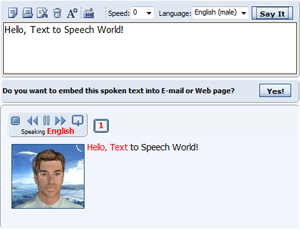
 Use a text to speech page to ensure the correct pronunciation of your speech.

Imtranslator: write your text and listen to it!
  • Use any of the websites below
  • Copy and paste excerpts of your speech into the window you'll on the right
  • Choose speed, language (English) and avatar
  • Listen and take notes 
Link to imtranslator  (see picture) page:  HERE  
Link to acapellla page: HERE  

Link to natural readers page:  HERE


Thanks to our teacher trainer Mike O'Neill for providing us with the link to  the natural readers page. Course 77 at the British Council Summer 2012.